Topics › KS3 › Geometry & measures
Angle facts
-
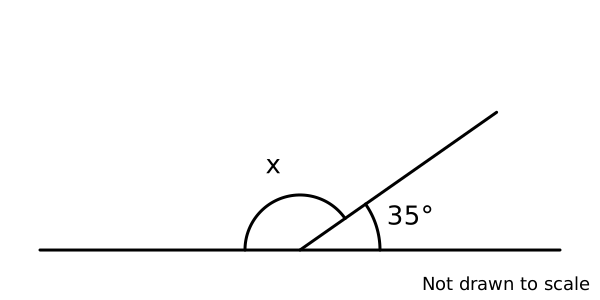
The diagram shows a straight line. What is the size of angle $x$?
A
Option A:
$325^\circ$
B
Option B:
$35^\circ$
C
Option C:
$145^\circ$
D
Option D:
$55^\circ$
Answer and misconceptions
A
Option A:
$325^\circ$
✗
Uses 360° for angles on a straight lineCalculates 360 − 35, mixing up angles on a line with angles around a point.
B
Option B:
$35^\circ$
✗
Assumes the two angles are equalTreats the angles as if they were vertically opposite, so gives 35°.
C
Option C:
$145^\circ$
✓ Correct
D
Option D:
$55^\circ$
✗
Uses 90° for angles on a straight lineCalculates 90 − 35, confusing a straight line with a right angle.
-
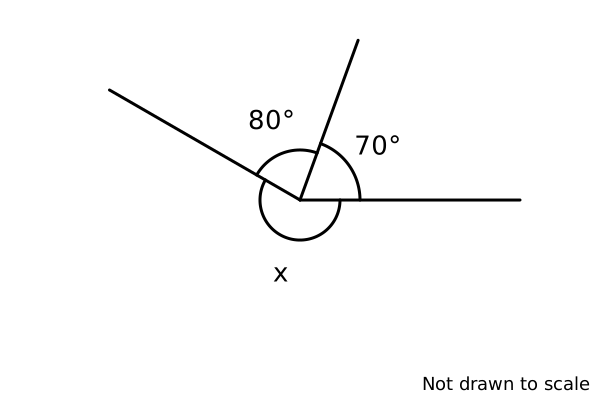
Three lines meet at a point. What is the size of angle $x$?
A
Option A:
$210^\circ$
B
Option B:
$30^\circ$
C
Option C:
$150^\circ$
D
Option D:
$120^\circ$
Answer and misconceptions
A
Option A:
$210^\circ$
✓ Correct
B
Option B:
$30^\circ$
✗
Uses 180° for angles around a pointCalculates 180 − 70 − 80, using the straight-line total instead of 360°.
C
Option C:
$150^\circ$
✗
Thinks x equals the sum of the other two anglesAdds 70 + 80 and stops, as if x were equal to the sum of the known angles.
D
Option D:
$120^\circ$
✗
Assumes angles around a point are equalDivides 360 by 3, ignoring the given angles.
-
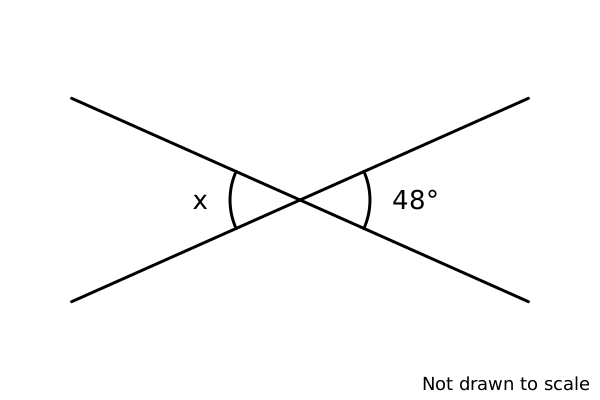
Two straight lines cross. What is the size of angle $x$?
A
Option A:
$132^\circ$
B
Option B:
$312^\circ$
C
Option C:
$42^\circ$
D
Option D:
$48^\circ$
Answer and misconceptions
A
Option A:
$132^\circ$
✗
Treats opposite angles as on a straight lineCalculates 180 − 48, using the rule for adjacent angles instead of vertically opposite angles.
B
Option B:
$312^\circ$
✗
Subtracts from 360° for opposite anglesCalculates 360 − 48, thinking the two opposite angles make a full turn.
C
Option C:
$42^\circ$
✗
Confuses vertically opposite with complementaryCalculates 90 − 48, confusing vertically opposite with complementary angles.
D
Option D:
$48^\circ$
✓ Correct
-
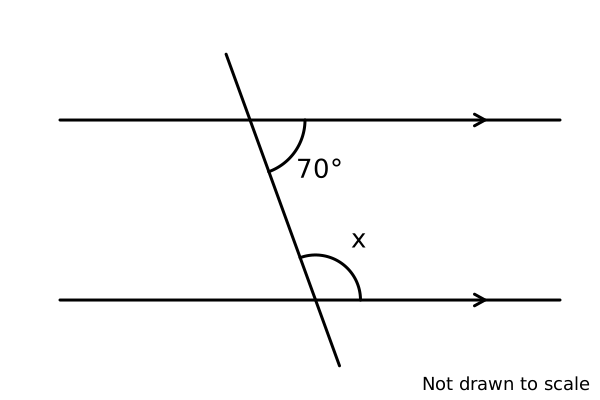
The two horizontal lines are parallel. What is the size of angle $x$?
A
Option A:
$70^\circ$
B
Option B:
$110^\circ$
C
Option C:
$290^\circ$
D
Option D:
$20^\circ$
Answer and misconceptions
A
Option A:
$70^\circ$
✗
Thinks co-interior angles are equalTreats these as alternate or corresponding angles; co-interior angles add to 180°.
B
Option B:
$110^\circ$
✓ Correct
C
Option C:
$290^\circ$
✗
Thinks co-interior angles add to 360°Calculates 360 − 70 instead of 180 − 70.
D
Option D:
$20^\circ$
✗
Thinks co-interior angles add to 90°Calculates 90 − 70, using a right angle as the total.
-
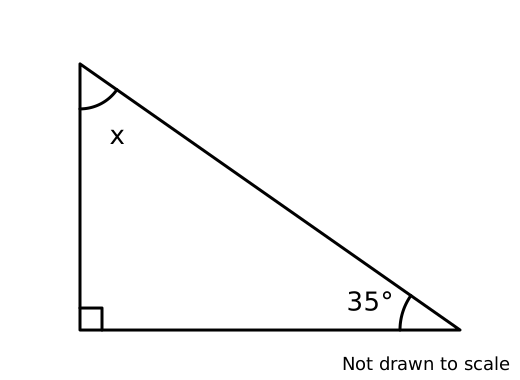
What is the size of angle $x$ in this triangle?
A
Option A:
$145^\circ$
B
Option B:
$235^\circ$
C
Option C:
$55^\circ$
D
Option D:
$35^\circ$
Answer and misconceptions
A
Option A:
$145^\circ$
✗
Ignores the right-angle markerCalculates 180 − 35, not counting the 90° shown by the square.
B
Option B:
$235^\circ$
✗
Uses 360° for angles in a triangleCalculates 360 − 90 − 35, using the quadrilateral total.
C
Option C:
$55^\circ$
✓ Correct
D
Option D:
$35^\circ$
✗
Assumes the two acute angles are equalThinks the triangle is isosceles, so x matches the 35° angle.
-
Three angles, $3x$, $2x$ and $x$, lie together on a straight line. What is the value of $x$?
A
Option A:
$60$
B
Option B:
$30$
C
Option C:
$36$
D
Option D:
$90$
Answer and misconceptions
A
Option A:
$60$
✗
Uses $360^\circ$ for angles on a straight lineWrites $6x = 360$; angles on a straight line add up to $180^\circ$, so $6x = 180$.
B
Option B:
$30$
✓ Correct
C
Option C:
$36$
✗
Does not count $x$ as $1x$ when collecting termsAdds $3x + 2x = 5x$ and leaves out the lone $x$, so solves $5x = 180$.
D
Option D:
$90$
✗
Gives the largest angle instead of $x$Finds $x = 30$ correctly, then gives $3x = 90$ as the answer.