Topics › KS3 › Geometry & measures
Angles in polygons
-
What do the interior angles of a pentagon add up to?
A
Option A:
$900^\circ$
B
Option B:
$540^\circ$
C
Option C:
$360^\circ$
D
Option D:
$720^\circ$
Answer and misconceptions
A
Option A:
$900^\circ$
✗
Multiplies 180° by the number of sidesCalculates 5 × 180 instead of (5 − 2) × 180.
B
Option B:
$540^\circ$
✓ Correct
C
Option C:
$360^\circ$
✗
Thinks every polygon's angles add to 360°Applies the quadrilateral (or exterior angle) total to all polygons.
D
Option D:
$720^\circ$
✗
Uses (n − 1) × 180°Calculates 4 × 180; a pentagon splits into 3 triangles, not 4.
-
What is the size of one exterior angle of a regular hexagon?
A
Option A:
$120^\circ$
B
Option B:
$30^\circ$
C
Option C:
$360^\circ$
D
Option D:
$60^\circ$
Answer and misconceptions
A
Option A:
$120^\circ$
✗
Gives the interior angle instead120° is the interior angle; the exterior angle is 180 − 120 = 60°.
B
Option B:
$30^\circ$
✗
Thinks exterior angles add to 180°Calculates 180 ÷ 6 instead of 360 ÷ 6.
C
Option C:
$360^\circ$
✗
Gives the total of all the exterior angles360° is the sum of all six exterior angles, not one of them.
D
Option D:
$60^\circ$
✓ Correct
-
What is the size of one interior angle of a regular octagon?
A
Option A:
$135^\circ$
B
Option B:
$45^\circ$
C
Option C:
$1080^\circ$
D
Option D:
$157.5^\circ$
Answer and misconceptions
A
Option A:
$135^\circ$
✓ Correct
B
Option B:
$45^\circ$
✗
Gives the exterior angle instead360 ÷ 8 = 45° is the exterior angle; the interior angle is 180 − 45.
C
Option C:
$1080^\circ$
✗
Gives the sum, not one angle(8 − 2) × 180 = 1080° is the total; it still needs dividing by 8.
D
Option D:
$157.5^\circ$
✗
Uses (n − 1) × 180° for the angle sumCalculates 7 × 180 ÷ 8 instead of 6 × 180 ÷ 8.
-
Each exterior angle of a regular polygon is $30^\circ$. How many sides does it have?
A
Option A:
$150$
B
Option B:
$6$
C
Option C:
$12$
D
Option D:
$14$
Answer and misconceptions
A
Option A:
$150$
✗
Finds the interior angle instead of the sidesCalculates 180 − 30 = 150, which is an angle, not the number of sides.
B
Option B:
$6$
✗
Thinks exterior angles add to 180°Calculates 180 ÷ 30 instead of 360 ÷ 30.
C
Option C:
$12$
✓ Correct
D
Option D:
$14$
✗
Mixes in n − 2 from the interior angle sumTreats 360 ÷ 30 = 12 as n − 2, so adds 2 to get 14.
-
What is the size of angle $x$ in this quadrilateral?
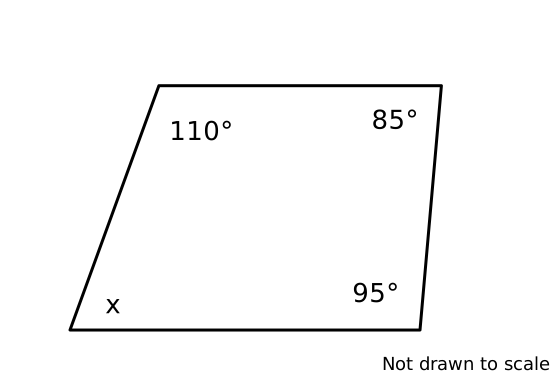
A
Option A:
$85^\circ$
B
Option B:
$70^\circ$
C
Option C:
$250^\circ$
D
Option D:
$290^\circ$
Answer and misconceptions
A
Option A:
$85^\circ$
✗
Assumes opposite angles are equalOpposite angles are only equal in a parallelogram; this shape is not one.
B
Option B:
$70^\circ$
✓ Correct
C
Option C:
$250^\circ$
✗
Uses 540° for a quadrilateralCalculates 540 − 290, using the pentagon total.
D
Option D:
$290^\circ$
✗
Gives the total of the known anglesAdds 95 + 85 + 110 = 290 and stops without subtracting from 360°.
-
What do the interior angles of any quadrilateral add up to?
A
Option A:
$180^\circ$
B
Option B:
$540^\circ$
C
Option C:
$360^\circ$
D
Option D:
$720^\circ$
Answer and misconceptions
A
Option A:
$180^\circ$
✗
Thinks every polygon has angles adding to $180^\circ$Uses the triangle fact for all shapes; a quadrilateral splits into 2 triangles, so $2 \times 180^\circ$.
B
Option B:
$540^\circ$
✗
Splits into one triangle fewer than the number of sidesUses $(4 - 1) \times 180^\circ$; a polygon with $n$ sides splits into $n - 2$ triangles.
C
Option C:
$360^\circ$
✓ Correct
D
Option D:
$720^\circ$
✗
Multiplies the number of sides by $180^\circ$Thinks each side makes a triangle, giving $4 \times 180^\circ$.