Topics › KS3 › Geometry & measures
Area of circles
-
A circle has radius $5\text{ cm}$. What is its area, in terms of $\pi$?
A
Option A:
$10\pi\text{ cm}^2$
B
Option B:
$25\pi\text{ cm}^2$
C
Option C:
$100\pi\text{ cm}^2$
D
Option D:
$5\pi\text{ cm}^2$
Answer and misconceptions
A
Option A:
$10\pi\text{ cm}^2$
✗
Confuses area with circumferenceUses 2πr = 10π, the circumference formula.
B
Option B:
$25\pi\text{ cm}^2$
✓ Correct
C
Option C:
$100\pi\text{ cm}^2$
✗
Doubles the radius before squaringUses the diameter, 10, in πr², giving π × 10².
D
Option D:
$5\pi\text{ cm}^2$
✗
Forgets to square the radiusCalculates π × 5 instead of π × 5².
-
What is the area of this circle, in terms of $\pi$?
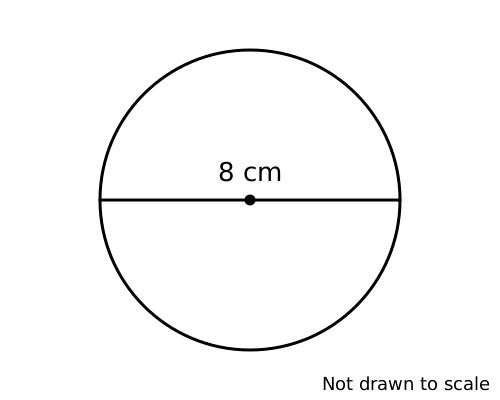
A
Option A:
$16\pi\text{ cm}^2$
B
Option B:
$64\pi\text{ cm}^2$
C
Option C:
$8\pi\text{ cm}^2$
D
Option D:
$32\pi\text{ cm}^2$
Answer and misconceptions
A
Option A:
$16\pi\text{ cm}^2$
✓ Correct
B
Option B:
$64\pi\text{ cm}^2$
✗
Uses the diameter as the radiusCalculates π × 8²; the radius is half the diameter, 4 cm.
C
Option C:
$8\pi\text{ cm}^2$
✗
Confuses area with circumferenceUses πd = 8π, the circumference formula.
D
Option D:
$32\pi\text{ cm}^2$
✗
Halves after squaring the diameterCalculates π × 8² ÷ 2 instead of π × (8 ÷ 2)².
-
A circle has radius $3\text{ cm}$. Use the $\pi$ button to find its area, to 1 decimal place.
A
Option A:
$18.8\text{ cm}^2$
B
Option B:
$113.1\text{ cm}^2$
C
Option C:
$28.3\text{ cm}^2$
D
Option D:
$9.4\text{ cm}^2$
Answer and misconceptions
A
Option A:
$18.8\text{ cm}^2$
✗
Confuses area with circumferenceCalculates 2 × π × 3 = 18.8, the circumference.
B
Option B:
$113.1\text{ cm}^2$
✗
Doubles the radius before squaringCalculates π × 6², using the diameter in place of the radius.
C
Option C:
$28.3\text{ cm}^2$
✓ Correct
D
Option D:
$9.4\text{ cm}^2$
✗
Forgets to square the radiusCalculates π × 3 = 9.4 instead of π × 3².
-
What is the area of this semicircle, in terms of $\pi$?
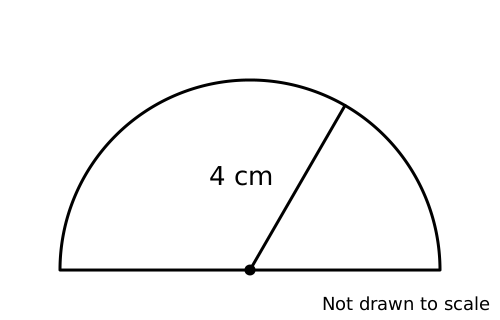
A
Option A:
$16\pi\text{ cm}^2$
B
Option B:
$4\pi\text{ cm}^2$
C
Option C:
$32\pi\text{ cm}^2$
D
Option D:
$8\pi\text{ cm}^2$
Answer and misconceptions
A
Option A:
$16\pi\text{ cm}^2$
✗
Finds the area of the whole circleCalculates π × 4² but forgets to halve for a semicircle.
B
Option B:
$4\pi\text{ cm}^2$
✗
Divides by 4 for a semicircleCalculates π × 4² ÷ 4, the area of a quarter circle.
C
Option C:
$32\pi\text{ cm}^2$
✗
Uses the diameter as the radiusCalculates π × 8² ÷ 2, doubling the 4 cm radius first.
D
Option D:
$8\pi\text{ cm}^2$
✓ Correct
-
A circle has area $49\pi\text{ cm}^2$. What is its radius?
A
Option A:
$7\text{ cm}$
B
Option B:
$49\text{ cm}$
C
Option C:
$24.5\text{ cm}$
D
Option D:
$14\text{ cm}$
Answer and misconceptions
A
Option A:
$7\text{ cm}$
✓ Correct
B
Option B:
$49\text{ cm}$
✗
Forgets to square rootSees πr² = 49π and gives r = 49 instead of r² = 49.
C
Option C:
$24.5\text{ cm}$
✗
Thinks squaring means doublingHalves 49 to undo r², treating r² as 2r.
D
Option D:
$14\text{ cm}$
✗
Gives the diameter, not the radiusFinds r = 7 correctly, then doubles it.