Topics › KS3 › Algebra

Coordinates & straight-line graphs

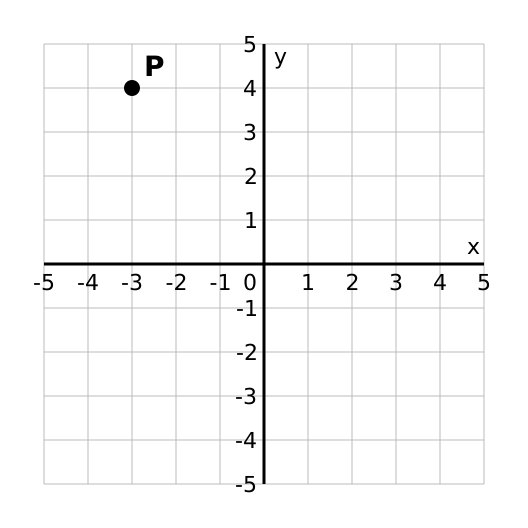
  1. What are the coordinates of point P?

    A coordinate grid from −5 to 5 on both axes. Point P is 3 squares left of the origin and 4 squares up.
    Option A: $(4, -3)$
    Option B: $(-3, 4)$
    Option C: $(3, 4)$
    Option D: $(-4, 5)$
    Answer and misconceptions
    Option A: $(4, -3)$ ✗
    Writes the y-coordinate firstSwaps the order of the coordinates, giving (up, across).
    Option B: $(-3, 4)$ ✓ Correct
    Option C: $(3, 4)$ ✗
    Ignores direction left of the originCounts 3 squares across but does not make it negative.
    Option D: $(-4, 5)$ ✗
    Counts the origin as 1Counts grid lines starting at 1 on the axis, so each value is one too far.
  2. Which point lies on the line $y = 2x + 1$?

    Option A: $(7, 3)$
    Option B: $(3, 6)$
    Option C: $(3, 8)$
    Option D: $(3, 7)$
    Answer and misconceptions
    Option A: $(7, 3)$ ✗
    Writes the coordinates in the wrong orderFinds y = 7 when x = 3, then writes the point as (y, x).
    Option B: $(3, 6)$ ✗
    Ignores the constant termUses y = 2x, so y = 6 when x = 3.
    Option C: $(3, 8)$ ✗
    Adds before multiplyingWorks out 2 × (3 + 1) instead of 2 × 3 + 1.
    Option D: $(3, 7)$ ✓ Correct
  3. What is the gradient of the line $y = 5 - 3x$?

    Option A: $5$
    Option B: $3$
    Option C: $-3$
    Option D: $-3x$
    Answer and misconceptions
    Option A: $5$ ✗
    Takes the first number as the gradientExpects y = mx + c order, so takes 5 as m.
    Option B: $3$ ✗
    Ignores the sign of the x coefficientIdentifies the x term but drops the negative.
    Option C: $-3$ ✓ Correct
    Option D: $-3x$ ✗
    Includes the x in the gradientGives the whole x term rather than its coefficient.
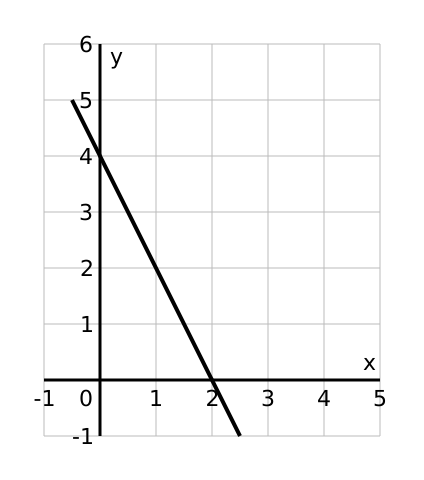
  4. What is the gradient of this line?

    A straight line on a grid. It crosses the y-axis at 4 and the x-axis at 2, sloping down from left to right.
    Option A: $-2$
    Option B: $2$
    Option C: $4$
    Option D: $-\frac{1}{2}$
    Answer and misconceptions
    Option A: $-2$ ✓ Correct
    Option B: $2$ ✗
    Ignores that the line slopes downwardsFinds a steepness of 2 but does not make it negative.
    Option C: $4$ ✗
    Gives the y-intercept as the gradientReads where the line crosses the y-axis.
    Option D: $-\frac{1}{2}$ ✗
    Divides horizontal change by vertical changeCalculates run ÷ rise instead of rise ÷ run.
  5. Which line is parallel to $y = 4x - 1$?

    Option A: $y = 2x - 1$
    Option B: $y = 4x + 3$
    Option C: $y = -4x + 3$
    Option D: $y = \frac{1}{4}x + 3$
    Answer and misconceptions
    Option A: $y = 2x - 1$ ✗
    Thinks the same y-intercept means parallelMatches the −1 rather than the gradient.
    Option B: $y = 4x + 3$ ✓ Correct
    Option C: $y = -4x + 3$ ✗
    Thinks the sign of the gradient does not matterMatches the number 4 but not its sign.
    Option D: $y = \frac{1}{4}x + 3$ ✗
    Thinks parallel lines have reciprocal gradientsUses 1/4 instead of the same gradient 4.