Topics › KS3 › Ratio & proportion
Direct proportion
-
3 pens cost £1.20. How much do 6 pens cost?
A
Option A:
£4.20
B
Option B:
£0.60
C
Option C:
£2.40
D
Option D:
£7.20
Answer and misconceptions
A
Option A:
£4.20
✗
Adds instead of scalingSees 3 more pens and adds £3 to the cost, rather than doubling the cost.
B
Option B:
£0.60
✗
Scales the wrong way (more items, less cost)Halves the cost even though the number of pens has doubled.
C
Option C:
£2.40
✓ Correct
D
Option D:
£7.20
✗
Treats the given cost as the cost of oneMultiplies £1.20 by 6, as if £1.20 were the price of a single pen.
-
A recipe for 4 people uses 300 g of flour. How much flour is needed for 6 people?
A
Option A:
1800 g
B
Option B:
302 g
C
Option C:
200 g
D
Option D:
450 g
Answer and misconceptions
A
Option A:
1800 g
✗
Multiplies by the new amount without dividingWorks out 300 × 6, forgetting that 300 g is for 4 people, not 1.
B
Option B:
302 g
✗
Adds the difference in peopleSees 2 more people and adds 2 g; proportion needs multiplying by 6/4.
C
Option C:
200 g
✗
Uses the inverse scale factorMultiplies by 4/6, as if more people needed less flour.
D
Option D:
450 g
✓ Correct
-
Which pair of quantities is in direct proportion?
A
Option A:
Litres of petrol bought and the total cost
B
Option B:
A child's age and their height
C
Option C:
Number of workers and the time to build a wall
D
Option D:
Temperature in °C and temperature in °F
Answer and misconceptions
A
Option A:
Litres of petrol bought and the total cost
✓ Correct
B
Option B:
A child's age and their height
✗
Thinks anything that increases together is proportionalHeight grows with age but not at a constant rate, and not from zero.
C
Option C:
Number of workers and the time to build a wall
✗
Confuses direct with inverse proportionMore workers means less time: as one goes up the other goes down.
D
Option D:
Temperature in °C and temperature in °F
✗
Thinks a straight-line link with a start value is proportionalF = 1.8C + 32 is linear, but 0 °C is not 0 °F, so doubling °C does not double °F.
-
Which graph shows that $y$ is directly proportional to $x$?
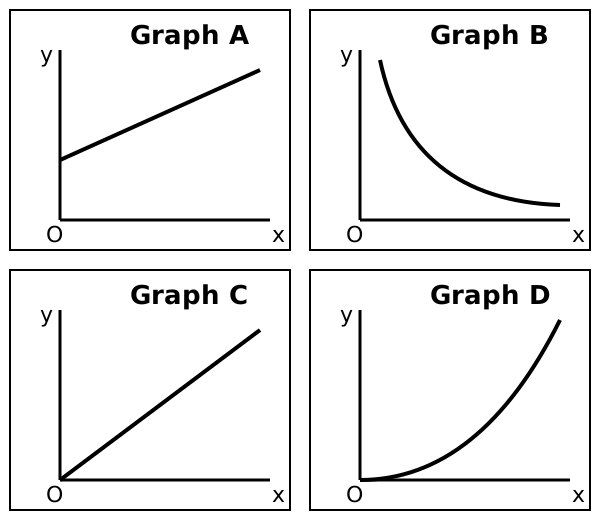
A
Option A:
Graph A
B
Option B:
Graph B
C
Option C:
Graph C
D
Option D:
Graph D
Answer and misconceptions
A
Option A:
Graph A
✗
Thinks any straight line shows direct proportionThe line does not pass through the origin, so y is not 0 when x is 0.
B
Option B:
Graph B
✗
Confuses direct with inverse proportionThis graph shows y falling as x rises (like inverse proportion), not direct proportion.
C
Option C:
Graph C
✓ Correct
D
Option D:
Graph D
✗
Thinks any graph through the origin is proportionalThe curve starts at (0, 0) but is not straight, so y is not a constant multiple of x.
-
$y = kx$. When $x = 4$, $y = 18$. What is the value of $k$?
A
Option A:
$\frac{2}{9}$
B
Option B:
$4.5$
C
Option C:
$14$
D
Option D:
$72$
Answer and misconceptions
A
Option A:
$\frac{2}{9}$
✗
Divides x by y to find kWorks out 4 ÷ 18 instead of 18 ÷ 4; k is y divided by x.
B
Option B:
$4.5$
✓ Correct
C
Option C:
$14$
✗
Subtracts to find the multiplierWorks out 18 − 4, thinking of the link between x and y as adding a constant.
D
Option D:
$72$
✗
Multiplies x and yWorks out 4 × 18, confusing y = kx with xy = k (inverse proportion).