Topics › KS3 › Geometry & measures
Perimeter & area
-
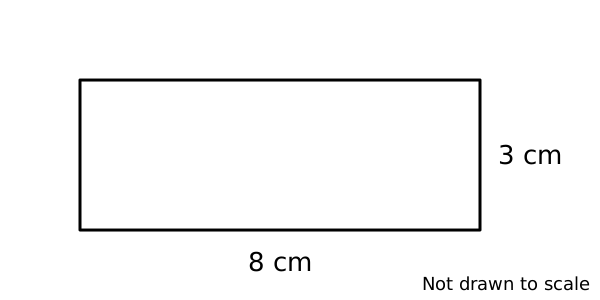
What is the perimeter of this rectangle?
A
Option A:
$22\text{ cm}$
B
Option B:
$11\text{ cm}$
C
Option C:
$24\text{ cm}$
D
Option D:
$19\text{ cm}$
Answer and misconceptions
A
Option A:
$22\text{ cm}$
✓ Correct
B
Option B:
$11\text{ cm}$
✗
Adds only the labelled sidesCalculates 8 + 3, forgetting the two unlabelled sides.
C
Option C:
$24\text{ cm}$
✗
Calculates the area insteadMultiplies 8 × 3, confusing perimeter with area.
D
Option D:
$19\text{ cm}$
✗
Uses 2l + w instead of 2(l + w)Doubles only the length: 2 × 8 + 3 = 19, forgetting the width also appears twice.
-
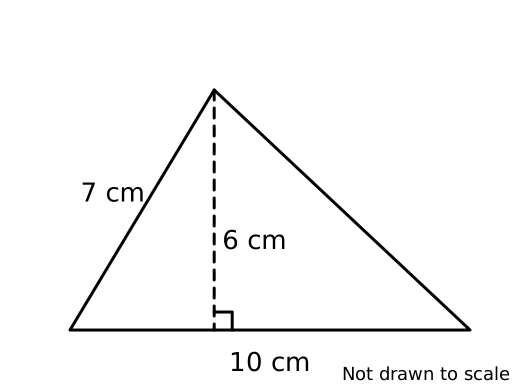
What is the area of this triangle?
A
Option A:
$60\text{ cm}^2$
B
Option B:
$35\text{ cm}^2$
C
Option C:
$23\text{ cm}^2$
D
Option D:
$30\text{ cm}^2$
Answer and misconceptions
A
Option A:
$60\text{ cm}^2$
✗
Forgets to halve base × heightCalculates 10 × 6, the area of the surrounding rectangle.
B
Option B:
$35\text{ cm}^2$
✗
Uses the sloping side as the heightCalculates ½ × 10 × 7; the height must be perpendicular to the base.
C
Option C:
$23\text{ cm}^2$
✗
Adds the lengths for areaCalculates 10 + 7 + 6, confusing area with adding lengths.
D
Option D:
$30\text{ cm}^2$
✓ Correct
-
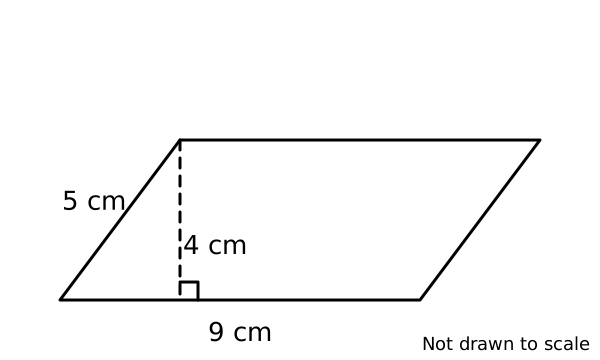
What is the area of this parallelogram?
A
Option A:
$45\text{ cm}^2$
B
Option B:
$18\text{ cm}^2$
C
Option C:
$36\text{ cm}^2$
D
Option D:
$28\text{ cm}^2$
Answer and misconceptions
A
Option A:
$45\text{ cm}^2$
✗
Multiplies base by the sloping sideCalculates 9 × 5; the height must be the perpendicular distance, 4 cm.
B
Option B:
$18\text{ cm}^2$
✗
Halves as if it were a triangleCalculates ½ × 9 × 4, using the triangle formula for a parallelogram.
C
Option C:
$36\text{ cm}^2$
✓ Correct
D
Option D:
$28\text{ cm}^2$
✗
Calculates the perimeter insteadCalculates 9 + 5 + 9 + 5, confusing area with perimeter.
-
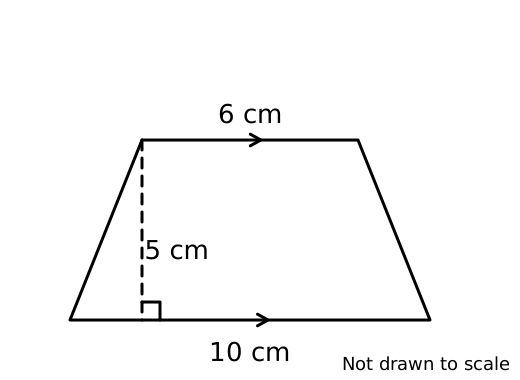
What is the area of this trapezium?
A
Option A:
$80\text{ cm}^2$
B
Option B:
$40\text{ cm}^2$
C
Option C:
$300\text{ cm}^2$
D
Option D:
$50\text{ cm}^2$
Answer and misconceptions
A
Option A:
$80\text{ cm}^2$
✗
Forgets to halve in the trapezium formulaCalculates (6 + 10) × 5 without multiplying by ½.
B
Option B:
$40\text{ cm}^2$
✓ Correct
C
Option C:
$300\text{ cm}^2$
✗
Multiplies all the given lengthsCalculates 6 × 10 × 5, thinking area means multiplying every number.
D
Option D:
$50\text{ cm}^2$
✗
Treats it as a rectangle using the longest sideCalculates 10 × 5, ignoring the shorter parallel side.
-
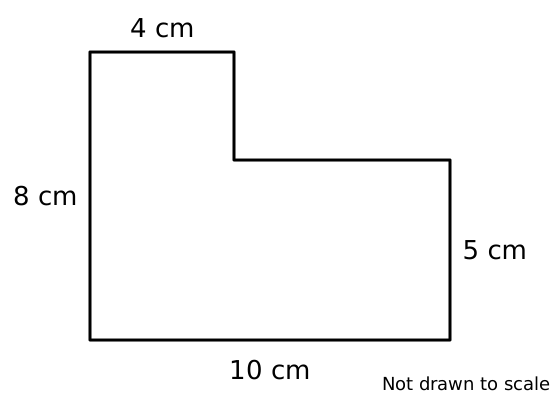
All corners are right angles. What is the perimeter of this shape?
A
Option A:
$27\text{ cm}$
B
Option B:
$62\text{ cm}$
C
Option C:
$33\text{ cm}$
D
Option D:
$36\text{ cm}$
Answer and misconceptions
A
Option A:
$27\text{ cm}$
✗
Adds only the labelled sidesCalculates 10 + 8 + 4 + 5, missing the two unlabelled sides (6 cm and 3 cm).
B
Option B:
$62\text{ cm}$
✗
Calculates the area insteadFinds 10 × 5 + 4 × 3 = 62, confusing perimeter with area.
C
Option C:
$33\text{ cm}$
✗
Includes only one of the missing sidesAdds the inner 6 cm side but misses the inner 3 cm side.
D
Option D:
$36\text{ cm}$
✓ Correct