Topics › KS3 › Probability
Probability scale
-
What is the probability of rolling a 7 on an ordinary six-sided dice?
A
Option A:
$\frac{1}{7}$
B
Option B:
$0$
C
Option C:
$1$
D
Option D:
$-1$
Answer and misconceptions
A
Option A:
$\frac{1}{7}$
✗
Counts the event as one of the outcomesTreats 7 as one extra possible outcome out of 7, when it cannot happen at all.
B
Option B:
$0$
✓ Correct
C
Option C:
$1$
✗
Confuses the ends of the scaleThinks 1 means impossible; 1 means certain and 0 means impossible.
D
Option D:
$-1$
✗
Thinks impossible events are negativeProbabilities are never below 0; impossible is exactly 0.
-
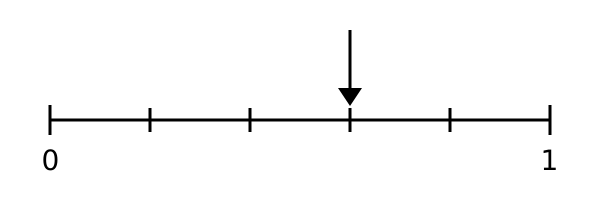
The scale is split into equal parts. What probability does the arrow show?
A
Option A:
$0.3$
B
Option B:
$3$
C
Option C:
$0.6$
D
Option D:
$0.4$
Answer and misconceptions
A
Option A:
$0.3$
✗
Assumes every mark is worth 0.1Counts 3 marks as tenths without checking there are only 5 parts, each worth 0.2.
B
Option B:
$3$
✗
Gives the number of marks, not the valueCounts the marks from 0 and gives 3, which cannot be a probability.
C
Option C:
$0.6$
✓ Correct
D
Option D:
$0.4$
✗
Reads the scale from the wrong endCounts 2 parts back from 1 and gives the distance from 1 (0.4) instead of from 0.
-
Which of these cannot be a probability?
A
Option A:
$0$
B
Option B:
$1$
C
Option C:
$70\%$
D
Option D:
$\frac{3}{2}$
Answer and misconceptions
A
Option A:
$0$
✗
Thinks 0 is not a probabilityAn impossible event has probability 0, so 0 is allowed.
B
Option B:
$1$
✗
Thinks probabilities must be less than 1A certain event has probability 1, so 1 is allowed.
C
Option C:
$70\%$
✗
Thinks probabilities cannot be percentages70% is the same as 0.7, which is a valid probability.
D
Option D:
$\frac{3}{2}$
✓ Correct
-
The probability that it rains tomorrow is $0.3$. What is the probability that it does not rain tomorrow?
A
Option A:
$0.7$
B
Option B:
$-0.3$
C
Option C:
$0.3$
D
Option D:
$1.3$
Answer and misconceptions
A
Option A:
$0.7$
✓ Correct
B
Option B:
$-0.3$
✗
Uses a minus sign for notWrites the negative of 0.3; probabilities cannot be negative. Use 1 − 0.3.
C
Option C:
$0.3$
✗
Thinks not happening has the same probabilityAssumes an event and its opposite are equally likely.
D
Option D:
$1.3$
✗
Adds to 1 instead of subtractingWorks out 1 + 0.3; the two probabilities must add up to 1.
-
A bag has 3 red counters and 1 blue counter. One counter is picked at random. What is the probability it is red?
A
Option A:
$\frac{1}{2}$
B
Option B:
$\frac{3}{1}$
C
Option C:
$\frac{3}{4}$
D
Option D:
$\frac{1}{4}$
Answer and misconceptions
A
Option A:
$\frac{1}{2}$
✗
Thinks two colours means a 50:50 chanceTreats red and blue as equally likely because there are two colours.
B
Option B:
$\frac{3}{1}$
✗
Writes red over blue, not red over the totalUses the ratio red : blue as the probability; the denominator should be all 4 counters.
C
Option C:
$\frac{3}{4}$
✓ Correct
D
Option D:
$\frac{1}{4}$
✗
Gives the probability of the other colourFinds the probability of blue (1 out of 4) instead of red.
-
A spinner can land on red, blue or green. $P(\text{red}) = 0.35$ and $P(\text{blue}) = 0.4$. What is $P(\text{green})$?
A
Option A:
$0.25$
B
Option B:
$0.75$
C
Option C:
$0.65$
D
Option D:
$0.05$
Answer and misconceptions
A
Option A:
$0.25$
✓ Correct
B
Option B:
$0.75$
✗
Gives the total of the known probabilitiesWorks out $0.35 + 0.4 = 0.75$ and stops; that is $P(\text{red or blue})$, so green is $1 - 0.75$.
C
Option C:
$0.65$
✗
Subtracts only one probability from 1Works out $1 - 0.35 = 0.65$, forgetting that blue also has to be taken away.
D
Option D:
$0.05$
✗
Finds the difference between the two probabilitiesWorks out $0.4 - 0.35 = 0.05$; the three probabilities must add up to 1.