Topics › KS3 › Geometry & measures
Pythagoras
-
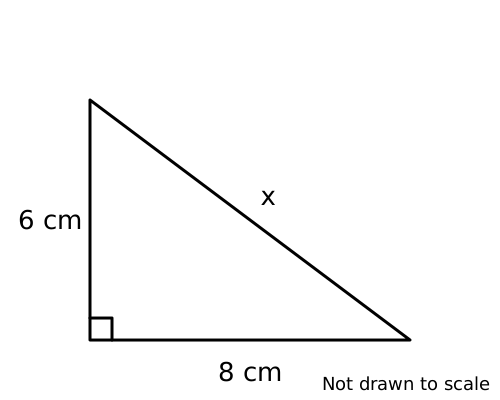
What is the length of the hypotenuse $x$? Give answers to 1 decimal place where needed.
A
Option A:
$10\text{ cm}$
B
Option B:
$14\text{ cm}$
C
Option C:
$100\text{ cm}$
D
Option D:
$5.3\text{ cm}$
Answer and misconceptions
A
Option A:
$10\text{ cm}$
✓ Correct
B
Option B:
$14\text{ cm}$
✗
Adds the side lengthsCalculates 6 + 8 instead of using the squares of the sides.
C
Option C:
$100\text{ cm}$
✗
Forgets to square root at the endFinds 6² + 8² = 100 and stops; x² = 100, so x = 10.
D
Option D:
$5.3\text{ cm}$
✗
Subtracts squares to find the hypotenuseCalculates √(8² − 6²); subtraction is only for finding a shorter side.
-
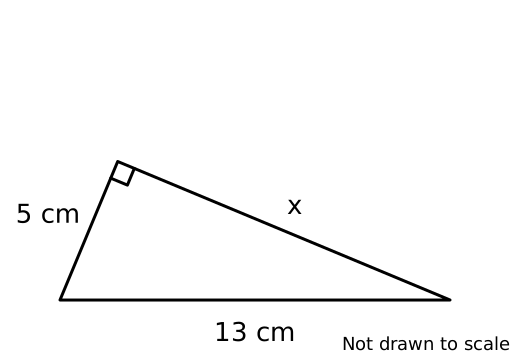
What is the length of side $x$? Give answers to 1 decimal place where needed.
A
Option A:
$13.9\text{ cm}$
B
Option B:
$8\text{ cm}$
C
Option C:
$144\text{ cm}$
D
Option D:
$12\text{ cm}$
Answer and misconceptions
A
Option A:
$13.9\text{ cm}$
✗
Always adds the squaresCalculates √(13² + 5²), treating x as the hypotenuse; x is a shorter side.
B
Option B:
$8\text{ cm}$
✗
Subtracts the lengths, not their squaresCalculates 13 − 5 without squaring.
C
Option C:
$144\text{ cm}$
✗
Forgets to square root at the endFinds 13² − 5² = 144 and stops; x² = 144, so x = 12.
D
Option D:
$12\text{ cm}$
✓ Correct
-
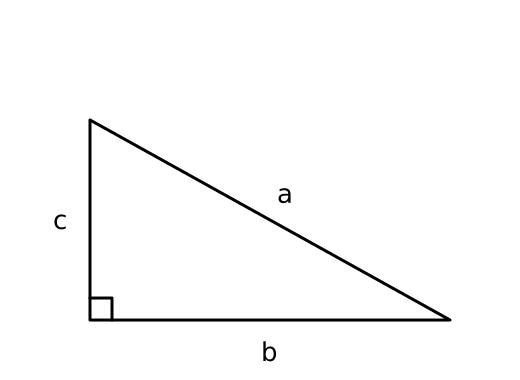
Which equation is true for this right-angled triangle?
A
Option A:
$a^2 + b^2 = c^2$
B
Option B:
$b^2 + c^2 = a^2$
C
Option C:
$b + c = a$
D
Option D:
$a^2 + c^2 = b^2$
Answer and misconceptions
A
Option A:
$a^2 + b^2 = c^2$
✗
Assumes c is always the hypotenuseUses the memorised a² + b² = c² without checking which side is opposite the right angle.
B
Option B:
$b^2 + c^2 = a^2$
✓ Correct
C
Option C:
$b + c = a$
✗
Adds lengths without squaringThinks the two shorter sides add up to the hypotenuse.
D
Option D:
$a^2 + c^2 = b^2$
✗
Takes the horizontal base as the hypotenuseThe hypotenuse is the side opposite the right angle, which is a.
-
What is the distance between the points $(1, 2)$ and $(4, 6)$? Give answers to 1 decimal place where needed.
A
Option A:
$7$
B
Option B:
$25$
C
Option C:
$5$
D
Option D:
$9.4$
Answer and misconceptions
A
Option A:
$7$
✗
Adds the horizontal and vertical distancesCalculates 3 + 4; the straight-line distance is the hypotenuse, √(3² + 4²).
B
Option B:
$25$
✗
Forgets to square root at the endFinds 3² + 4² = 25 and stops.
C
Option C:
$5$
✓ Correct
D
Option D:
$9.4$
✗
Adds coordinates instead of finding differencesCalculates √((1 + 4)² + (2 + 6)²) = √89; it should use 4 − 1 and 6 − 2.
-
Which three lengths could be the sides of a right-angled triangle?
A
Option A:
$7, 24, 25$
B
Option B:
$4, 5, 6$
C
Option C:
$5, 7, 12$
D
Option D:
$2, 3, 13$
Answer and misconceptions
A
Option A:
$7, 24, 25$
✓ Correct
B
Option B:
$4, 5, 6$
✗
Thinks any consecutive numbers work like 3, 4, 54² + 5² = 41, not 6² = 36.
C
Option C:
$5, 7, 12$
✗
Checks if the shorter sides add to the longestTests 5 + 7 = 12 instead of 5² + 7² = 12².
D
Option D:
$2, 3, 13$
✗
Forgets to square root the longest sideWorks out 2² + 3² = 13 and takes 13 as the side; it should be √13.