Topics › KS3 › Geometry & measures
Transformations
-
The point $(2, 4)$ is translated by the vector $\begin{pmatrix} 3 \\ -2 \end{pmatrix}$. Where does it end up?
A
Option A:
$(0, 7)$
B
Option B:
$(5, 6)$
C
Option C:
$(5, 2)$
D
Option D:
$(-1, 6)$
Answer and misconceptions
A
Option A:
$(0, 7)$
✗
Reads the vector the wrong way roundMoves −2 in x and 3 in y; the top number is the horizontal move.
B
Option B:
$(5, 6)$
✗
Ignores the negative sign in the vectorMoves up 2 instead of down 2.
C
Option C:
$(5, 2)$
✓ Correct
D
Option D:
$(-1, 6)$
✗
Translates in the opposite directionSubtracts the vector: moves left 3 and up 2.
-
The point $(1, 4)$ is reflected in the line $x = 3$. Where is its image?
A
Option A:
$(5, 4)$
B
Option B:
$(1, 2)$
C
Option C:
$(-1, 4)$
D
Option D:
$(4, 1)$
Answer and misconceptions
A
Option A:
$(5, 4)$
✓ Correct
B
Option B:
$(1, 2)$
✗
Thinks x = 3 is a horizontal lineReflects in y = 3; the line x = 3 is vertical.
C
Option C:
$(-1, 4)$
✗
Reflects in the y-axis insteadIgnores the given mirror line and just changes the sign of x.
D
Option D:
$(4, 1)$
✗
Swaps the coordinatesSwapping x and y reflects in y = x, not in x = 3.
-
The point $(3, 1)$ is rotated $90^\circ$ clockwise about the origin. Where is its image?
A
Option A:
$(-1, 3)$
B
Option B:
$(-3, -1)$
C
Option C:
$(1, 3)$
D
Option D:
$(1, -3)$
Answer and misconceptions
A
Option A:
$(-1, 3)$
✗
Rotates anticlockwise instead of clockwise(−1, 3) is the result of a 90° anticlockwise turn.
B
Option B:
$(-3, -1)$
✗
Rotates 180° instead of 90°Changes both signs, which is a half turn.
C
Option C:
$(1, 3)$
✗
Swaps coordinates without changing a signSwapping alone is a reflection in y = x, not a rotation.
D
Option D:
$(1, -3)$
✓ Correct
-
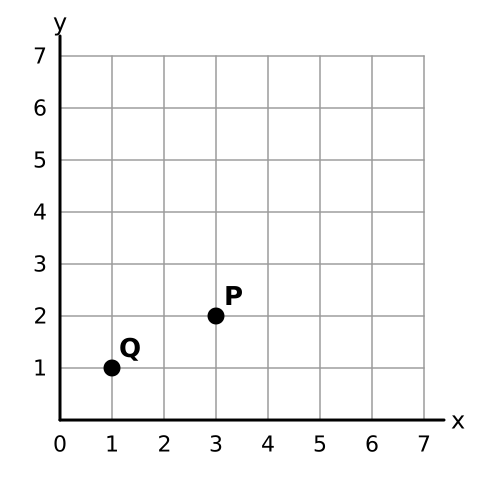
Point $P$ is enlarged by scale factor $2$, centre $Q$. What are the coordinates of the image of $P$?
A
Option A:
$(6, 4)$
B
Option B:
$(5, 3)$
C
Option C:
$(5, 4)$
D
Option D:
$(7, 4)$
Answer and misconceptions
A
Option A:
$(6, 4)$
✗
Enlarges from the origin, ignoring the centreDoubles the coordinates of P instead of doubling its distance from Q.
B
Option B:
$(5, 3)$
✓ Correct
C
Option C:
$(5, 4)$
✗
Adds the scale factor to each coordinateAdds 2 to x and y instead of multiplying the distance from Q by 2.
D
Option D:
$(7, 4)$
✗
Measures the doubled distance from P, not QDoubles the move from Q to P to get 4 right, 2 up, but counts it from P instead of from Q.
-
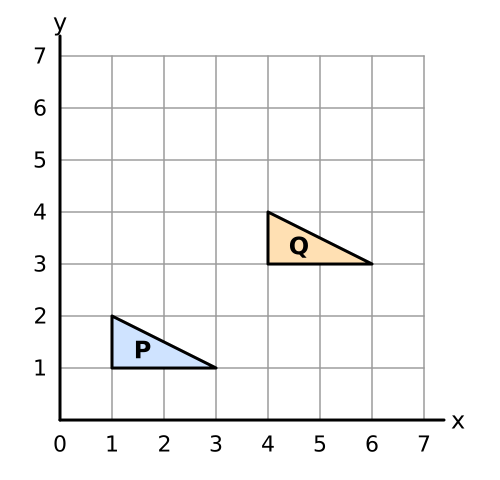
Which vector describes the translation from shape P to shape Q?
A
Option A:
$\begin{pmatrix} 2 \\ 3 \end{pmatrix}$
B
Option B:
$\begin{pmatrix} -3 \\ -2 \end{pmatrix}$
C
Option C:
$\begin{pmatrix} 3 \\ 2 \end{pmatrix}$
D
Option D:
$\begin{pmatrix} 4 \\ 3 \end{pmatrix}$
Answer and misconceptions
A
Option A:
$\begin{pmatrix} 2 \\ 3 \end{pmatrix}$
✗
Writes the vector with x and y swappedThe top number is the horizontal move (3 right), the bottom the vertical (2 up).
B
Option B:
$\begin{pmatrix} -3 \\ -2 \end{pmatrix}$
✗
Describes the move from Q back to PReverses the direction; P to Q is right and up, so both are positive.
C
Option C:
$\begin{pmatrix} 3 \\ 2 \end{pmatrix}$
✓ Correct
D
Option D:
$\begin{pmatrix} 4 \\ 3 \end{pmatrix}$
✗
Gives a coordinate of Q, not the movement(4, 3) is where a corner of Q is; the vector is how far each point moves.