Topics › KS3 › Geometry & measures
Volume of prisms
-
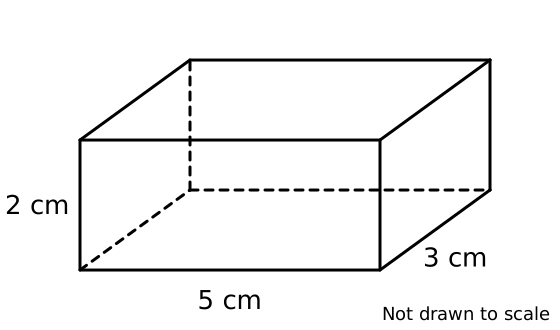
What is the volume of this cuboid?
A
Option A:
$10\text{ cm}^3$
B
Option B:
$62\text{ cm}^3$
C
Option C:
$15\text{ cm}^3$
D
Option D:
$30\text{ cm}^3$
Answer and misconceptions
A
Option A:
$10\text{ cm}^3$
✗
Adds the dimensionsCalculates 5 + 3 + 2 instead of multiplying.
B
Option B:
$62\text{ cm}^3$
✗
Calculates the surface area insteadFinds 2(5×3 + 5×2 + 3×2) = 62, confusing volume with surface area.
C
Option C:
$15\text{ cm}^3$
✗
Multiplies only two dimensionsCalculates 5 × 3, the area of one face, and forgets the third dimension.
D
Option D:
$30\text{ cm}^3$
✓ Correct
-
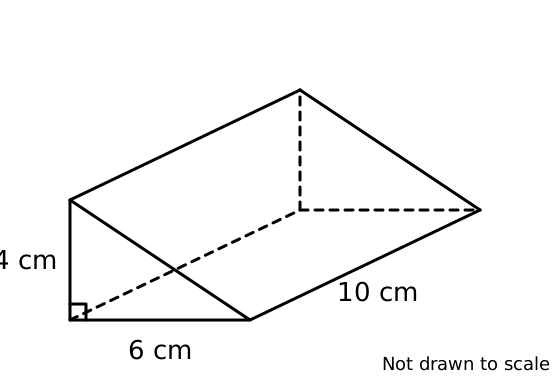
What is the volume of this triangular prism?
A
Option A:
$240\text{ cm}^3$
B
Option B:
$120\text{ cm}^3$
C
Option C:
$20\text{ cm}^3$
D
Option D:
$12\text{ cm}^3$
Answer and misconceptions
A
Option A:
$240\text{ cm}^3$
✗
Forgets to halve for the triangleCalculates 6 × 4 × 10, the volume of a cuboid.
B
Option B:
$120\text{ cm}^3$
✓ Correct
C
Option C:
$20\text{ cm}^3$
✗
Adds the dimensionsCalculates 6 + 4 + 10 instead of multiplying.
D
Option D:
$12\text{ cm}^3$
✗
Gives the cross-section area onlyFinds ½ × 6 × 4 = 12 but does not multiply by the length.
-
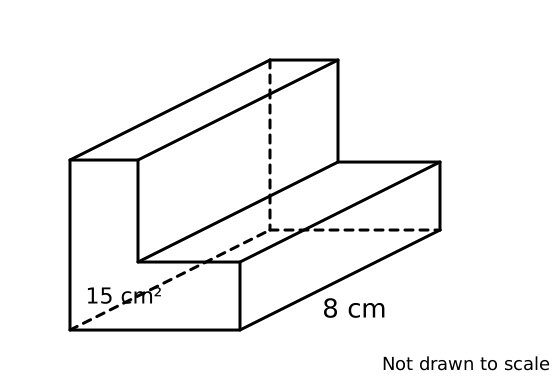
The end face of this prism has area $15\text{ cm}^2$. What is the volume of the prism?
A
Option A:
$23\text{ cm}^3$
B
Option B:
$60\text{ cm}^3$
C
Option C:
$120\text{ cm}^3$
D
Option D:
$40\text{ cm}^3$
Answer and misconceptions
A
Option A:
$23\text{ cm}^3$
✗
Adds the area and the lengthCalculates 15 + 8 instead of 15 × 8.
B
Option B:
$60\text{ cm}^3$
✗
Always halves, as for a triangular prismCalculates ½ × 15 × 8, applying the triangle ½ to every prism.
C
Option C:
$120\text{ cm}^3$
✓ Correct
D
Option D:
$40\text{ cm}^3$
✗
Divides by 3, as for a pyramidCalculates ⅓ × 15 × 8, using the pyramid formula.
-
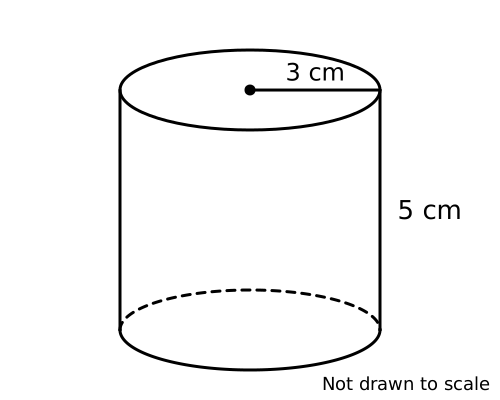
What is the volume of this cylinder, in terms of $\pi$?
A
Option A:
$45\pi\text{ cm}^3$
B
Option B:
$15\pi\text{ cm}^3$
C
Option C:
$30\pi\text{ cm}^3$
D
Option D:
$180\pi\text{ cm}^3$
Answer and misconceptions
A
Option A:
$45\pi\text{ cm}^3$
✓ Correct
B
Option B:
$15\pi\text{ cm}^3$
✗
Forgets to square the radiusCalculates π × 3 × 5 instead of π × 3² × 5.
C
Option C:
$30\pi\text{ cm}^3$
✗
Uses the circumference instead of the areaCalculates 2π × 3 × 5, which is the curved surface area.
D
Option D:
$180\pi\text{ cm}^3$
✗
Uses the diameter as the radiusCalculates π × 6² × 5, doubling the radius first.
-
How many $\text{cm}^3$ are in $1\text{ m}^3$?
A
Option A:
$100$
B
Option B:
$1\,000\,000$
C
Option C:
$10\,000$
D
Option D:
$1000$
Answer and misconceptions
A
Option A:
$100$
✗
Uses the length conversion for volumeMultiplies by 100 once, as for m to cm; it must be 100 × 100 × 100.
B
Option B:
$1\,000\,000$
✓ Correct
C
Option C:
$10\,000$
✗
Uses the area conversion for volumeUses 100², which converts m² to cm², not m³ to cm³.
D
Option D:
$1000$
✗
Mixes up with litres in 1 m³1 m³ is 1000 litres; each litre is a further 1000 cm³.