 Bean
</>
Computer Science
KS3 foundations, GCSE (OCR J277, Edexcel 1CP2, AQA 8525) and A-level (OCR H446, AQA 7517). Programming in Python, pseudocode, theory, exam technique and the A-level project.
Personalised tutoring in Computer Science from KS3 to A-level, and Maths from KS3 to GCSE. Learn from an experienced PhD educator and OCR GCSE examiner with 14+ years of teaching experience. Face-to-face in Jersey, or online anywhere.
Introductory price: one-to-one lessons £50 an hour £60. See all prices
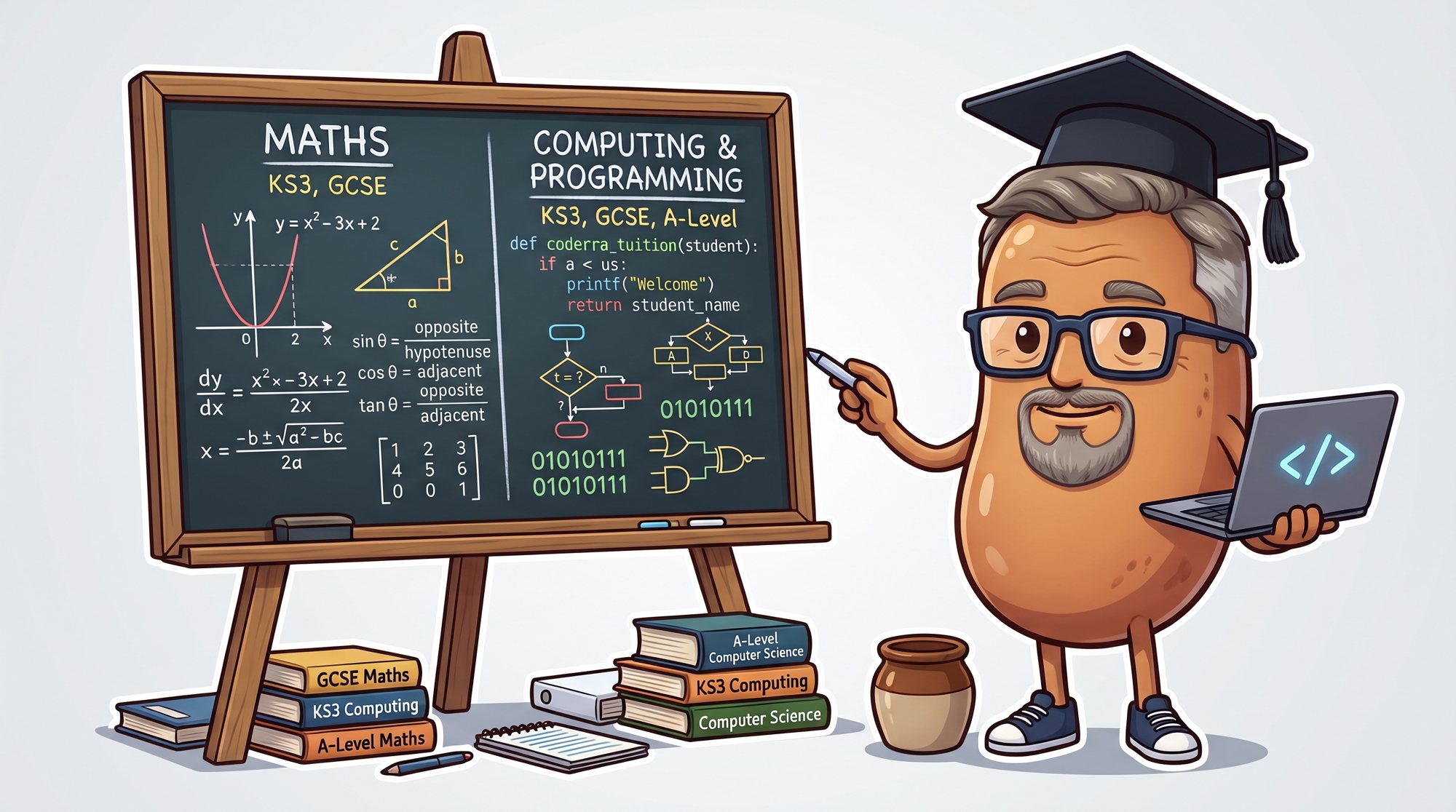
Both subjects, all the main exam boards. I specialise in students who are finding the subject hard and need to secure a grade 4 and push on from there, but I also work with students aiming higher.
KS3 foundations, GCSE (OCR J277, Edexcel 1CP2, AQA 8525) and A-level (OCR H446, AQA 7517). Programming in Python, pseudocode, theory, exam technique and the A-level project.
KS3 and GCSE Maths (Foundation and Higher, any board). Diagnostic questions to find the misconceptions first, then one idea at a time with visual explanations and plenty of practice.
Past-paper walk-throughs, command words, how marks are actually awarded, and what to do in the last six weeks. I mark GCSE Computer Science papers for OCR, so I know what examiners look for.
Every lesson mixes explanation with doing. Students don’t just watch: they build, trace and test their understanding as they go.
Students drag, drop, predict and test code in the browser, so every new idea is practised straight away. Nothing to install.
Try it yourself →Problems are broken into small steps. We trace programs line by line, then take the support away as confidence grows.
Try it yourself →Abstract ideas such as sorting algorithms, the CPU and logic gates become animations students can see, pause and replay.
Try it yourself →Students snap blocks together to build real Python, then run it in the browser. The code appears line by line as the program grows.
Try it yourself →Each flowchart shape is explained one step at a time and turned into the matching Python, so design and code stay connected.
Try it yourself →SELECT, FROM and WHERE become blocks that run against a real database, so students see exactly how each clause changes the results.
Try it yourself →An equation becomes a balance scale: do the same to both sides, watch it stay level, and keep going until x is on its own.
Try it yourself →Every wrong answer points to one specific misconception, so we find out exactly what to fix next instead of guessing.
Try it yourself →Linked topics open a free interactive activity on this site; the rest are covered in lessons.
Switch bits on and watch the denary value add up.
Build a program from blocks, see the code it makes, then run it.
A worked for-loop example, revealed one line at a time.
Step through FizzBuzz line by line, then run it.
Convert binary to hexadecimal to unlock each door.
Watch the registers update at every stage of the cycle.
Build a class, create objects, and call getters and setters.
Push, peek and pop to see last-in, first-out in action.
Watch the shortest distances update across the graph.
No big upfront blocks. We start small, find out what is actually needed, and you pay session by session.
A short conversation with you and your child about where things are, what the target is and when the exams are.
A short, exam-board-neutral test done at home. It shows me the gaps, and shows us both whether the student is ready to put the work in.
I recommend how many sessions and what we cover. If a few sessions will do it, I will say so.
Card or QR payment via SumUp, or bank transfer for ongoing students. An invoice for every lesson, no contracts.
I teach in Jersey secondary schools every week, so I know the curriculum as it is actually taught and where students typically get stuck.
Marking real GCSE scripts each summer means I can show students exactly how marks are won and lost.
Calm, step-by-step explanations, visual models and settings for neurodivergent learners run through everything I make and teach.
Individual attention, or bring a friend or two at the same level and split the cost. Groups are capped at three.
Same price either way. Online over Google Meet or Zoom; face-to-face at agreed locations in Jersey.
Students get access to the interactive activities, past-paper trainers and revision games on this site to keep going between lessons.
Hourly, pay as you go. 45-minute sessions are available for younger students. Full pricing and FAQ →
Introductory rate
£40 per student
About £33 per student · maximum group size
Everything I build for my own classes is free to use in the browser, on a phone, with no login. Over sixty tools so far. Browse the full collection →
A staged pathway through 80+ interactive maths topic pages, from foundations to the grade 4 core and the push to a 5, with easy-read and read-aloud settings.
Open →Interactive walk-throughs of real GCSE Computer Science papers, question by question with instant marking.
Open →Fifty marked Python exercises, a block editor that writes real Python, and a flowchart editor that steps through execution. Built for OCR J277.
Open →Write and run OCR GCSE pseudocode with Run, Step and Stop controls and a live variables panel.
Open →Seven quick games for key terms and recall, for any subject. Works offline once opened.
Open →Maths multiple-choice questions where every wrong answer reveals a named misconception. The same tool I use in the baseline check.
Open →Book a free 15-minute introductory call, or send a message and I will reply within a day.